
Wedding Day Timeline for Photographers: A Pro Guide
- 22 hours ago
- 8 min read

A wedding day timeline for photographers is a detailed schedule that maps every photo session, transition, and buffer from the first getting-ready shot to the last dance. Without one, photographers lose control of an 8–12 hour day where a single delay can collapse the entire shoot. Ataviaweddings, with over 16 years of experience across more than 1,600 weddings, treats the photography schedule as the backbone of every event. A well-built timeline does not just keep you on time. It protects the quality of every image you deliver.
What is a wedding day timeline and why do photographers need one?
A wedding day timeline is a photographer’s operational roadmap. It assigns specific time blocks to every major moment, from hair and makeup through the reception exit, so nothing gets skipped and no session gets rushed.
Photographers who skip formal timeline planning rely on memory and improvisation. That approach fails consistently because weddings involve multiple vendors, moving locations, and unpredictable family dynamics. A well-detailed timeline that includes start times, durations, and buffer periods gives photographers the structure to stay calm and creative under pressure.
Coordination with planners, officiants, and caterers is also far easier when you arrive with a written schedule. Vendors who understand the photography timeline respect session boundaries and avoid pulling the couple away at critical moments. The result is a smoother day for everyone, not just the photographer.
A strong photography schedule serves three core functions:
Client priority mapping. It forces a pre-wedding conversation about which moments matter most, so you allocate time accordingly.
Vendor alignment. Sharing the timeline with the planner, DJ, and caterer prevents conflicts over the couple’s time.
Quality protection. Rushed portraits produce flat, forgettable images. Scheduled sessions produce the work that fills your portfolio.
Key components of a photographer’s wedding day timeline
Every professional photography schedule follows a predictable structure, even when the details vary by couple. The segments below represent the core time blocks you need to plan around.
Session | Recommended Duration | Notes |
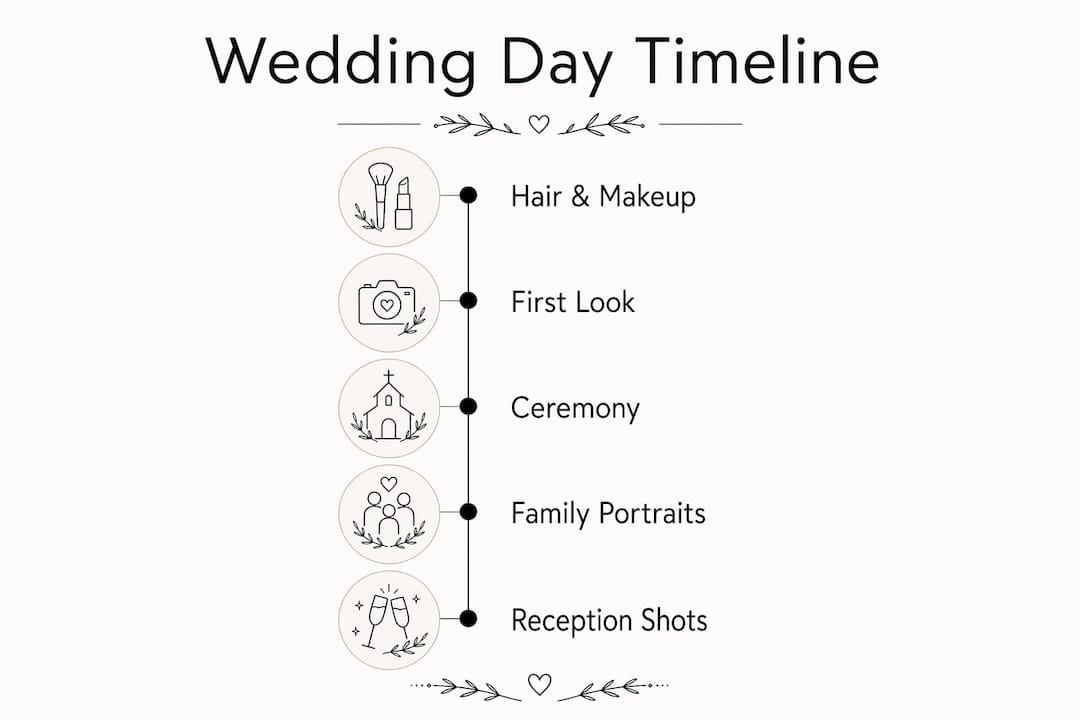
Hair and makeup | 2–3 hours | Photography begins when makeup is finishing |
Getting ready details | 30–45 minutes | Dress, rings, shoes, and candid prep shots |
First look | 15–20 minutes | Private reveal before ceremony |
Ceremony | 30–60 minutes | Varies by religious or civil format |
Family portraits | Depends on group size and complexity | |
Couple portraits (golden hour) | 20–30 minutes | Best natural light window of the day |
Reception coverage | 5–6 hours | Toasts, first dance, cake, open dancing |
The “ready by” rule is non-negotiable in professional timeline planning. Hair and makeup should be finishing when photography coverage begins. Starting portrait sessions with a half-dressed subject wastes the best natural light and compresses every session that follows.
Pro Tip: Schedule a 15-minute buffer after hair and makeup wraps before the first look. Brides and grooms almost always need a few minutes to collect themselves, and that window prevents a frantic start to the most emotionally charged part of the day.
How to build an effective wedding day timeline
Building a photography schedule from scratch takes less than an hour when you follow a consistent method. The process works backward from the ceremony and forward through the reception.
Lock the ceremony start time first. Every other session is anchored to this fixed point. Confirm it directly with the officiant, not just the couple.
Schedule preparation sessions backward. Count back from the ceremony to determine when getting-ready coverage must begin. Add the hair and makeup window on top of that.
Place the first look 60–90 minutes before the ceremony. This window allows time for couple portraits and family formals before guests arrive.
Block family portraits immediately after the ceremony. Guests are still present, energy is high, and the light is often still workable.
Reserve the golden hour window for couple portraits. This is typically 30–60 minutes before sunset and produces the most compelling images of the day.
Map reception milestones forward. Cocktail hour, grand entrance, toasts, first dance, cake cutting, and open dancing each need a time slot.
Insert 10–15 minute buffers between every major transition. This is the single most protective step in the entire process.
Building timelines around the ceremony and sharing them clearly across all vendors reduces confusion and improves day-of flow. Send the finalized schedule to the planner, DJ, caterer, and videographer at least one week before the wedding.
Pro Tip: Ask the couple for a “must-have shot list” during your planning call, then cross-reference it against your timeline. If a requested shot has no scheduled time slot, add one or have an honest conversation about what is realistic.
Adjust the timeline based on venue logistics. A venue with multiple locations for ceremony and reception requires travel time between sessions. A single-location venue compresses transitions and may give you extra portrait time. Factor in parking, elevator waits, and outdoor walking distances before finalizing any schedule.
Common challenges in wedding day timelines and how to avoid them
Timeline failures follow predictable patterns. Knowing them in advance lets you build defenses before the day arrives.
Underestimating hair and makeup time. Large bridal parties routinely run 30–60 minutes over the original estimate. Build your schedule around the worst-case finish time, not the ideal one.
Skipping travel time between venues. A 10-minute drive becomes 25 minutes when you factor in loading equipment, parking, and walking to the shoot location. Map every transition in advance.
Compressing family portraits. Family and group portraits take 15–45 minutes depending on group size. Photographers who schedule 15 minutes for a 40-person family list always run over.
Ignoring vendor conflicts. Caterers who start serving during the couple portrait session pull guests away and create background chaos. Share the timeline with every vendor.
Treating the timeline as fixed. Real weddings deviate from any plan. A timeline that has no flexibility built in fails the moment the ceremony runs long.
“Treat the timeline as a dynamic protection plan, not a rigid script. Buffer times absorb inevitable delays from preparation, travel, or group coordination to maintain overall schedule integrity.” — photo-logica.com
Communication is the most underused tool in timeline management. Walk the couple through the schedule during your final planning call. Explain why each buffer exists and what happens if a session runs short. Couples who understand the logic behind the timeline become active partners in keeping it on track.
Best practices for maximizing photo coverage within the timeline
A tight schedule does not mean sacrificed quality. The photographers who consistently deliver strong work under time pressure follow a short set of repeatable practices.
Use the first look to front-load portrait time. A first look session lasts 15–20 minutes and allows most couple portraits to happen before the ceremony. This removes the post-ceremony time crunch entirely and produces calmer, more natural images.
Prioritize your shot list by emotional weight, not chronology. The first dance and the father-daughter dance matter more to most couples than the cake cutting. Allocate time accordingly and let lower-priority moments compress if needed.
Coordinate with the videographer before the day. Photographers and videographers who have not discussed positioning end up blocking each other during the ceremony and first dance. A 15-minute pre-wedding walkthrough eliminates most conflicts. Strong photo and video storytelling depends on both teams working from the same plan.
Scout the venue before the wedding day. Knowing where the best natural light falls at 4 p.m. versus 6 p.m. lets you place portrait sessions at the right time, not just the convenient one.
Keep a printed copy of the timeline on your person. Phone batteries die and screens are hard to read in bright sunlight. A folded paper copy in your back pocket takes 30 seconds to check and never crashes.
Professional editing can recover some technical issues, but it cannot recover a missed moment. The timeline is your primary tool for making sure the moments exist in the first place.
Key Takeaways
A well-built photography schedule is the single most effective tool for protecting image quality and client satisfaction across a full wedding day.
Point | Details |
Anchor to ceremony time | Build every session backward and forward from the locked ceremony start time. |
Buffer every transition | Insert 10–15 minute buffers between major events to absorb real-world delays. |
Use the first look strategically | A 15–20 minute first look front-loads couple portraits and reduces post-ceremony pressure. |
Share the timeline with all vendors | Distributing the schedule to planners, DJs, and caterers prevents conflicts over the couple’s time. |
Adjust for venue logistics | Factor in travel time, parking, and location changes before finalizing any photography schedule. |
What 1,600 weddings taught me about timeline flexibility
After covering more than 1,600 weddings over 16 years, the pattern is clear. The photographers who struggle most are the ones who treat the timeline as a contract rather than a framework. Real weddings are unpredictable. Ceremonies run long. Flower girls refuse to walk. Grandmothers need extra time getting seated. None of that is a failure. It is just a wedding.
The buffer is not padding. It is the most professional thing on the entire schedule. Every 10-minute buffer you build is a decision to protect your client’s images rather than your own convenience. Photographers who skip buffers to squeeze in more sessions almost always deliver fewer usable images, not more.
The other lesson is about communication. Couples do not instinctively understand why a portrait session cannot start five minutes late. When you explain that a five-minute delay at 3 p.m. becomes a 25-minute delay by 5 p.m. because of cascading transitions, they get it immediately. That conversation, held before the wedding day, is worth more than any piece of equipment you own.
Build timelines that reflect what the couple actually values. Some couples care deeply about golden hour portraits. Others want maximum reception coverage. The best photography schedule is the one built around that specific couple’s priorities, not a generic template copied from a blog post.
— Atavia
How Ataviaweddings approaches wedding day coverage
Planning a wedding day timeline is one of the most detail-intensive parts of professional photography work. Ataviaweddings brings over 16 years of experience and a portfolio of more than 1,600 weddings to every booking, which means the timeline planning process is built into the service from the first client call.

Every Ataviaweddings package includes pre-wedding coordination designed to align the photography and videography schedule with the couple’s priorities and venue logistics. The combo packages cover both photo and video coverage, so both teams operate from a single unified timeline. Photographers looking for a proven approach to wedding day coverage can explore Ataviaweddings’ services and see the full gallery of real wedding work at ataviaweddings.com.
FAQ
What is a wedding day timeline for photographers?
A wedding day timeline for photographers is a detailed schedule that assigns time blocks to every major photo session, from getting-ready coverage through the reception. It includes session durations, buffer periods, and vendor coordination notes to keep the day running on schedule.
How long should a wedding photography timeline be?
Wedding days typically span 8–12 hours, so the photography timeline should cover that full window. Ceremonies run 30–60 minutes, and receptions are typically scheduled for 5–6 hours.
Why are buffer times so important in a wedding timeline?
Buffer time between events absorbs delays from preparation, travel, and group coordination. Without buffers, a single 10-minute delay early in the day can cascade into missed portrait sessions by evening.
When should family portraits be scheduled?
Family portraits work best immediately after the ceremony, when all guests are still present and the formal energy of the event is still high. Plan for 15–45 minutes depending on the size and complexity of the family groupings.
Does a first look save time on the wedding day?
Yes. A first look session lasts 15–20 minutes and allows most couple portraits to happen before the ceremony. This removes the post-ceremony time pressure and typically produces calmer, more natural images than rushed post-ceremony sessions.
Recommended
Comments